The Admirals by Walter R. Borneman
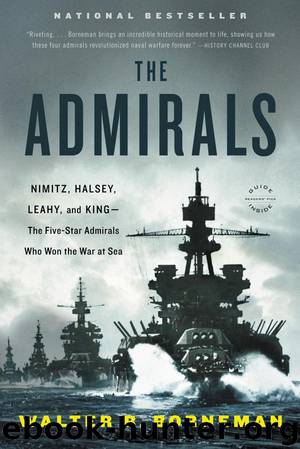
Author:Walter R. Borneman
Language: eng
Format: mobi, epub
ISBN: 9780316202527
Publisher: Little, Brown and Company
Published: 2012-04-30T21:00:00+00:00
The feared attack came, but the Allied ships reacted slowly and suffered great losses against a lightning assault by five Japanese heavy cruisers and two light cruisers. The Australian Canberra and three American cruisers—Astoria, Vincennes, and Quincy—sank with considerable loss of life, while the Chicago took a torpedo in the bow and two destroyers also were damaged. It was “the severest defeat in battle ever suffered by the U.S. Navy.”13
The only good news was that the Japanese cruisers had circled Savo Island and returned westward rather than pushing east and attacking the undefended transports off the beachheads. But the naval losses were so great—six ships and upwards of a thousand men—that King’s duty officer woke him in the middle of the night when the news finally reached Washington. King read the dispatch several times before asking that it be decoded again in hopes that there was an error. But the news was correct, and King called it “the blackest day of the war,” not to mention a clear setback for his policy of attack, attack, attack.14
Characteristically, Nimitz’s first reaction was calmly to rally his subordinates. Radio communications with Ghormley were wretched and were equally so among Ghormley’s commands. Adding to Nimitz’s confusion was the fact that the Japanese had changed their naval code. He was getting little information from his forces, little insight from Japanese code intercepts, and a steady stream of queries from King as to what was happening. As late as August 19, with Turner’s amphibious ships back in New Caledonia and sixteen thousand marines temporarily isolated on Guadalcanal and Tulagi, Nimitz could send King little more information than “our losses were heavy and there is still no explanation of why. The enemy seems to have suffered little or no damage.”15
Meanwhile, Japanese destroyers had landed nine hundred troops near the American beachhead on Guadalcanal. Turner desperately directed reinforcements of his own to the island, particularly marine fighters to the hurriedly completed airstrip at Henderson Field. Fletcher maneuvered his carriers out of range of Japanese land-based aircraft, but close enough to counter any assault by a major Japanese carrier force that was rumored to be forming at Truk, fifteen hundred miles to the north-northwest. The most nagging question was, when might an attack come?
Through this uncertainty, Fletcher began to rotate his three carrier groups one at a time to the south to refuel as conditions permitted. When aerial reconnaissance and radio intercepts seemed to indicate no immediate Japanese threat from Truk, Fletcher dispatched the Wasp group south to refuel, only to learn that a major Japanese force with the repaired Coral Sea carriers Shokaku and Zuikaku, the light carrier Ryujo, and substantial surface ships was bearing down on the eastern end of the Solomons.
Enterprise and Saratoga steamed to engage, and their planes sank the Ryujo before a counterstrike from the main Japanese carriers severely damaged Enterprise. The “Big E” made for Pearl Harbor under its own steam, but a week later, a Japanese submarine torpedoed Fletcher’s flagship, Saratoga, and this carrier, too, was forced to limp to Pearl Harbor for repairs.
Download
This site does not store any files on its server. We only index and link to content provided by other sites. Please contact the content providers to delete copyright contents if any and email us, we'll remove relevant links or contents immediately.
| Africa | Americas |
| Arctic & Antarctica | Asia |
| Australia & Oceania | Europe |
| Middle East | Russia |
| United States | World |
| Ancient Civilizations | Military |
| Historical Study & Educational Resources |
Cat's cradle by Kurt Vonnegut(15362)
Pimp by Iceberg Slim(14517)
4 3 2 1: A Novel by Paul Auster(12398)
Underground: A Human History of the Worlds Beneath Our Feet by Will Hunt(12100)
The Radium Girls by Kate Moore(12033)
Wiseguy by Nicholas Pileggi(5791)
The Fire Next Time by James Baldwin(5452)
Perfect Rhythm by Jae(5409)
American History Stories, Volume III (Yesterday's Classics) by Pratt Mara L(5310)
Paper Towns by Green John(5194)
Pale Blue Dot by Carl Sagan(5012)
A Higher Loyalty: Truth, Lies, and Leadership by James Comey(4965)
The Mayflower and the Pilgrims' New World by Nathaniel Philbrick(4506)
The Doomsday Machine by Daniel Ellsberg(4492)
Killers of the Flower Moon: The Osage Murders and the Birth of the FBI by David Grann(4449)
The Sympathizer by Viet Thanh Nguyen(4396)
Too Much and Not the Mood by Durga Chew-Bose(4349)
The Borden Murders by Sarah Miller(4329)
Sticky Fingers by Joe Hagan(4204)
